Conflict Market

“Conflict Market” Research Article
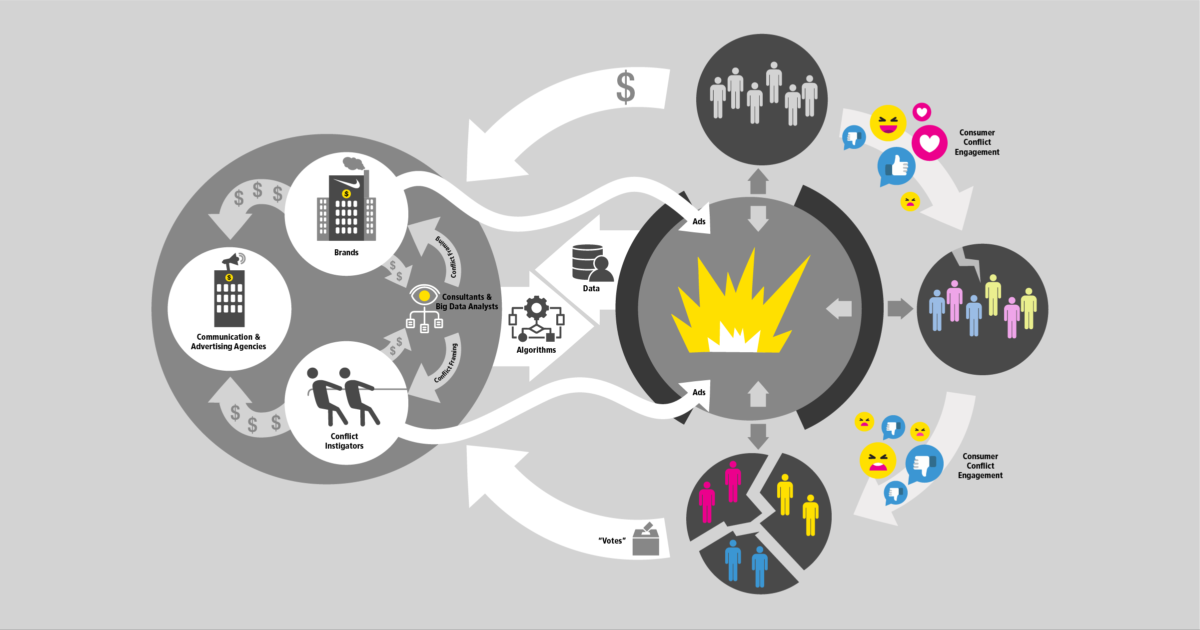
Conflict Market - Sofia Ulver

Here you can read my first introduction of the ‘Conflict Market’ as a notion published in Journal of Consumer Culture 2022. The abstract reads:

“At the beginning of the millennium, consumer culture researchers predicted that people
would increasingly demand that marketplace actors subscribe to contemporary ethics of
liberal democracy. Although their prediction indeed came true, they did not foresee that
an algorithm-powered media ecosystem in combination with growing authoritarian
movements would soon come to fuel an increasingly polarized political landscape and
challenge the very fundament of liberal democracy per se. In this macroscopic, conceptual
article, I discuss three assumption-challenging logics—counter-democratic consumer
culture, de-dialectical algorithmic manipulation, and growing illiberal consumer
resistance—according to which the market increasingly monetizes the conflicts accompanying
this polarization and, thereby, reinforces it. I call this new logic a conflict
market and illustrate it through three, historically situated and currently conflicting,
consumer ideoscapes—the neoblue, the neogreen, and the neobrown—between which
consumers engage in marketized conflicts, not in a de-politicizing way, but in an increasingly
un-politicizing, de-dialectical, and polarizing way. At the technologically manipulated
conflict market, the role of marketers is to monetize politically sensitive topics
by creating conflict, knowingly renouncing large groups of consumers, and giving fodder
to the political extremes.”


“Conflict Market” Research Grant

Conflict Markets: An investigation of the market’s role in a violent consumer culture

Between 2023 and 2025 I am generously funded by Riksbankens Jubileumsfond to empirically develop my theory of “conflict market”. In light of daily reports on anti-democratic actions and violent organized crime in different countries, marketing scholars have called for more research to add marketing voices to the conversation about radicalization and democracy issues. Since these important issues have just recently been addressed from a marketing perspective, the research at hand aims to develop this burgeoning research area guided by the following broad purpose-driven questions: what can marketing do to address radicalization, and how can marketing knowledge help society, policymakers, consumers and companies to prevent radicalization? Through digital methods in social media, in combination with ethnographic fieldwork, this study will empirically investigate a so called “conflict market” (Ulver 2022) – namely the consumer culture of Swedish gangster rap – and explore the linkages between its “echo chambers” and “brand publics” (Arvidsson & Caliandro 2016) where radicalization and prevention against radicalization can take place. Such linkages will on the one hand be approached by looking at consumer rituals, culture, imaginaries, norms and language – through fieldwork as well as digitally– and on the other hand by looking at the role marketing and branding play, both in terms of how marketing notions, logics and techniques are used by radicalizing groups, and how mainstream market actors (un)willingly may contribute to polarization and radicalization through the tempting monetization of conflict.

“Plant versus Cow: Conflict Framing ..” Research Article in JMMK

In this article I and Christian Koch explore and identify the way famous brands (in this case Oatly) amplify and capitalize on conflict in their advertising. Here the orchestrated conflict is between an animal-based food industry framed as corrupt and misogynist, and a plant-based food industry framed as wholesome and fair. This is the abstract:

“In this article we focus on the cultural mechanisms of market evolution accompanying the marketplace discord between a market actor and a dominant industry. We situate our analysis in the intersection between marketing and institutional theory and engage specifically with the constructs of legitimacy and framing strategies, but also with Chantal Mouffe’s political philosophy concept of agonistics. To better understand the blurry impact of market-driven activism and conflict on the shaping of markets, we use the ongoing “milk-war” between plant- versus animal-based drink producers as backdrop, and empirically explore how a market actor and their supporting institutional actors frame a previously legitimate industry in an attempt to delegitimize it, without sacrificing its consumer market. We find a rhetorical juggling-act of attempted legitimization of the market alternative and delegitimization of the status quo, where the intricacy of framing strategies constitutes what we call conflict framing. In line with the market-critical fundaments of agonistics, this conflict framing can work to (partly) delegitimize the status quo industry and to relegitimize its market at the same time, but cannot radically disrupt the system. Drawing from research predicting a growing absorption of politicized conflict by the market in general, we problematize and critique a potential rise in presence of marketmediated conflict framing. Our insights contribute to ongoing conversations on market evolution, markets for alternatives, ethical consumption and the ideological functioning of markets.”

“Tickling Tensions” Research Article in MT

In this article I go into the manifestations of what I later, in the “Conflict Market”, call the “neoblue” and “neogreen” movements  and explore how “woke” branding gives fodder to the fantasies of the “neobrown” movement. This is the abstract:

“This article explores why cultural branding – ideo-affective market communication addressing intense political tensions – paradoxically seems to lead to political inertia rather than political mobilization. I critically analyse advertising addressing political tensions related to race, ethnicity and immigration, but instead of only following the traced-out trajectory of postcolonial theory, I use the lens of Žižek’s radicalized Lacanian psychoanalysis and treat the therapeutic visuality in cultural branding as ideological fantasies of the market’s multicultural imaginary. Through critical visual methodologies, I situate four ‘multicultural’ commercials in their culture- and idea historical contexts, and juxtapose a postcolonial with a Žižekian reading for each of them. I come to argue that the market’s multicultural imaginary (unconsciously) serves important ideological functions in sustaining the political status quo not foremost because it placates anxiety, but because it doesn’t. Tapping into previous discussions in critical marketing on fetishistic disavowal and inversion, I offer yet another explanation. The political inertia following from ideo-affective dimensions of cultural branding does not primarily come from therapeutic sedation, but from the opposite, namely the parallax object’s upholding of gruesome tension and suspense; a fetishistic tickling. This article ends by critiquing the compulsory use of postcolonial theory in research on racial and ethnic relations. From the Žižekian reading, it appears that the postcolonial gaze is now a punishing agency like any dominant ideology, where the social inequality of global capitalism is deemed a more bearable alternative than the traumatic horror of visible racism, which, subsequently, closes the circuit from radical politics.”


“Political Ideology in Consumer Resistance” Research Article JPP&M

This article, which I published together with Christofer Laurell in Journal of Public Policy & Marketing, is the first of my publications that comes to lead up to “Conflict Market”  in that it gives some depth regarding what kinds of political ideologies that lurk behind various consumer resistance movements., especially what I later call the neobrown ideoscape in consumer culture. This is the abstract:

“Political ideologies of the far-right are gaining ground in world politics and culture, not least by way of market forces. It has therefore become urgent to understand how these ideologies manifest themselves in the fields of marketing and consumption at a sociocultural level. The authors explore the discursive efforts in far-right consumer resistance to advance a political agenda through protests directed at brands’ multicultural advertising and analyze how these consumers conceptualize their adversaries in the marketplace. In contrast to previous framings of adversaries identified in consumer research, where resistance is typically anticapitalist and directed toward firms’ unethical conduct or the exploitation by the global market economy per se, the authors find that the following discursive themes stand out in the far-right consumer resistance: the emphasis on the state as main antagonist, the indifference to capitalism as a potential adversary, and overt contestation of liberal ethics. The article concludes with a discussion of research contributions as well as the public policy and marketing implications in light of a growing far-right consumer culture.”