Conflict Market

Research Article in Marketing Theory “Inclusionary Labour: Theorizing…”
Please see below abstract from my colleague Hossain Shahriar and my new article in Marketing Theory:

Marketing and consumer research predominantly conceptualize inclusion and exclusion as dichotomous or merely coexisting, leaving their relationship undertheorized. This paper explores their dialectical interplay in market interactions through the experiences of migrant consumers. Drawing on Relational Dialectics Theory, we employ a contrapuntal methodological approach that integrates a semantic network analysis of the interpretive marketing and consumer research literature with a hermeneutic analysis of interviews with Bangladeshi immigrants in Sweden. Our findings identify four competing discourses that structure four key relational dimensions, generating corresponding experiences of inclusion and exclusion. These tensions persist as self-sustaining dynamics in which moments of inclusion and exclusion are relationally co-produced through ongoing discursive struggle. We conceptualize “inclusionary labor” as the disproportionate work that ethnically marginalized consumers undertake to be included. The study theorizes marketplace inclusion and exclusion as dialectically co-constitutive and reframes migrant consumer vulnerability as a relational condition that is often outsourced by markets to marginalized consumers.

To cite: Shahriar, H., & Ulver, S. (2025). Inclusionary labor: Theorizing the relationship between consumers’ inclusion and exclusion in the marketplace. Marketing Theory, 0(0). https://doi.org/10.1177/14705931251406915
“Conflict Market” Research Article

Conflict Market - Sofia Ulver

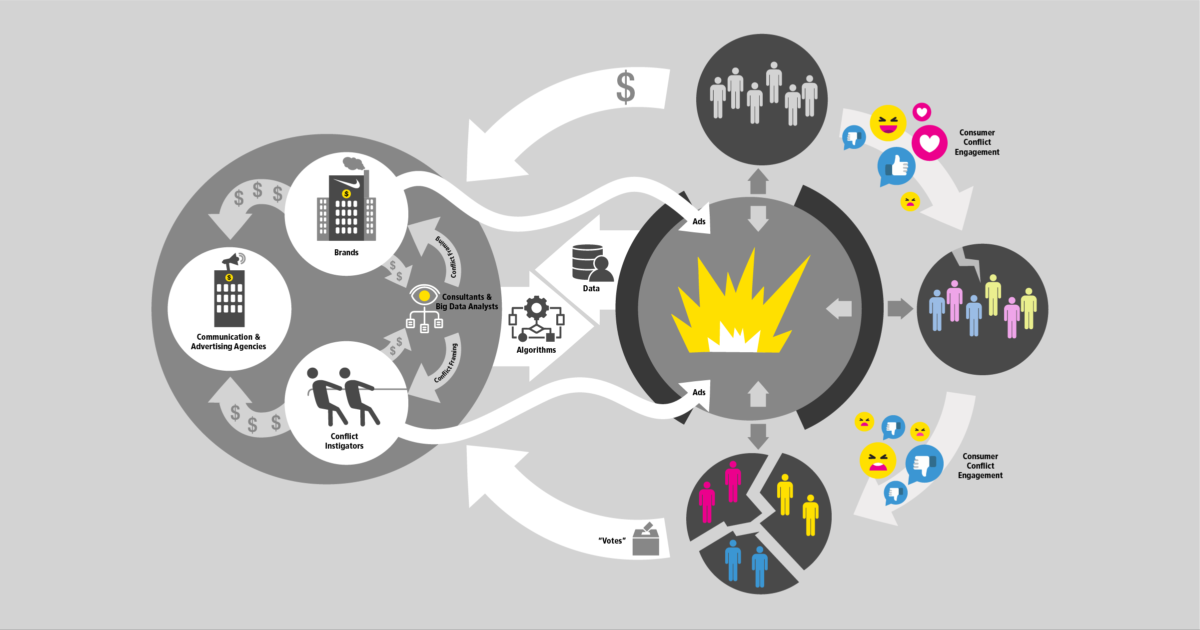
Here you can read my first introduction of the ‘Conflict Market’ as a notion published in Journal of Consumer Culture 2022. The abstract reads:

“At the beginning of the millennium, consumer culture researchers predicted that people
would increasingly demand that marketplace actors subscribe to contemporary ethics of
liberal democracy. Although their prediction indeed came true, they did not foresee that
an algorithm-powered media ecosystem in combination with growing authoritarian
movements would soon come to fuel an increasingly polarized political landscape and
challenge the very fundament of liberal democracy per se. In this macroscopic, conceptual
article, I discuss three assumption-challenging logics—counter-democratic consumer
culture, de-dialectical algorithmic manipulation, and growing illiberal consumer
resistance—according to which the market increasingly monetizes the conflicts accompanying
this polarization and, thereby, reinforces it. I call this new logic a conflict
market and illustrate it through three, historically situated and currently conflicting,
consumer ideoscapes—the neoblue, the neogreen, and the neobrown—between which
consumers engage in marketized conflicts, not in a de-politicizing way, but in an increasingly
un-politicizing, de-dialectical, and polarizing way. At the technologically manipulated
conflict market, the role of marketers is to monetize politically sensitive topics
by creating conflict, knowingly renouncing large groups of consumers, and giving fodder
to the political extremes.”

“Conflict Market” Research Grant

Conflict Markets: An investigation of the market’s role in a violent consumer culture

Between 2023 and 2025 I am generously funded by Riksbankens Jubileumsfond to empirically develop my theory of “conflict market”. In light of daily reports on anti-democratic actions and violent organized crime in different countries, marketing scholars have called for more research to add marketing voices to the conversation about radicalization and democracy issues. Since these important issues have just recently been addressed from a marketing perspective, the research at hand aims to develop this burgeoning research area guided by the following broad purpose-driven questions: what can marketing do to address radicalization, and how can marketing knowledge help society, policymakers, consumers and companies to prevent radicalization? Through digital methods in social media, in combination with ethnographic fieldwork, this study will empirically investigate a so called “conflict market” (Ulver 2022) – namely the consumer culture of Swedish gangster rap – and explore the linkages between its “echo chambers” and “brand publics” (Arvidsson & Caliandro 2016) where radicalization and prevention against radicalization can take place. Such linkages will on the one hand be approached by looking at consumer rituals, culture, imaginaries, norms and language – through fieldwork as well as digitally– and on the other hand by looking at the role marketing and branding play, both in terms of how marketing notions, logics and techniques are used by radicalizing groups, and how mainstream market actors (un)willingly may contribute to polarization and radicalization through the tempting monetization of conflict.